News
Google HackFest 2026 Showcases Student Innovation, Technical Excellence and Real-World Problem-Solving Achievements
01 Nov 2026
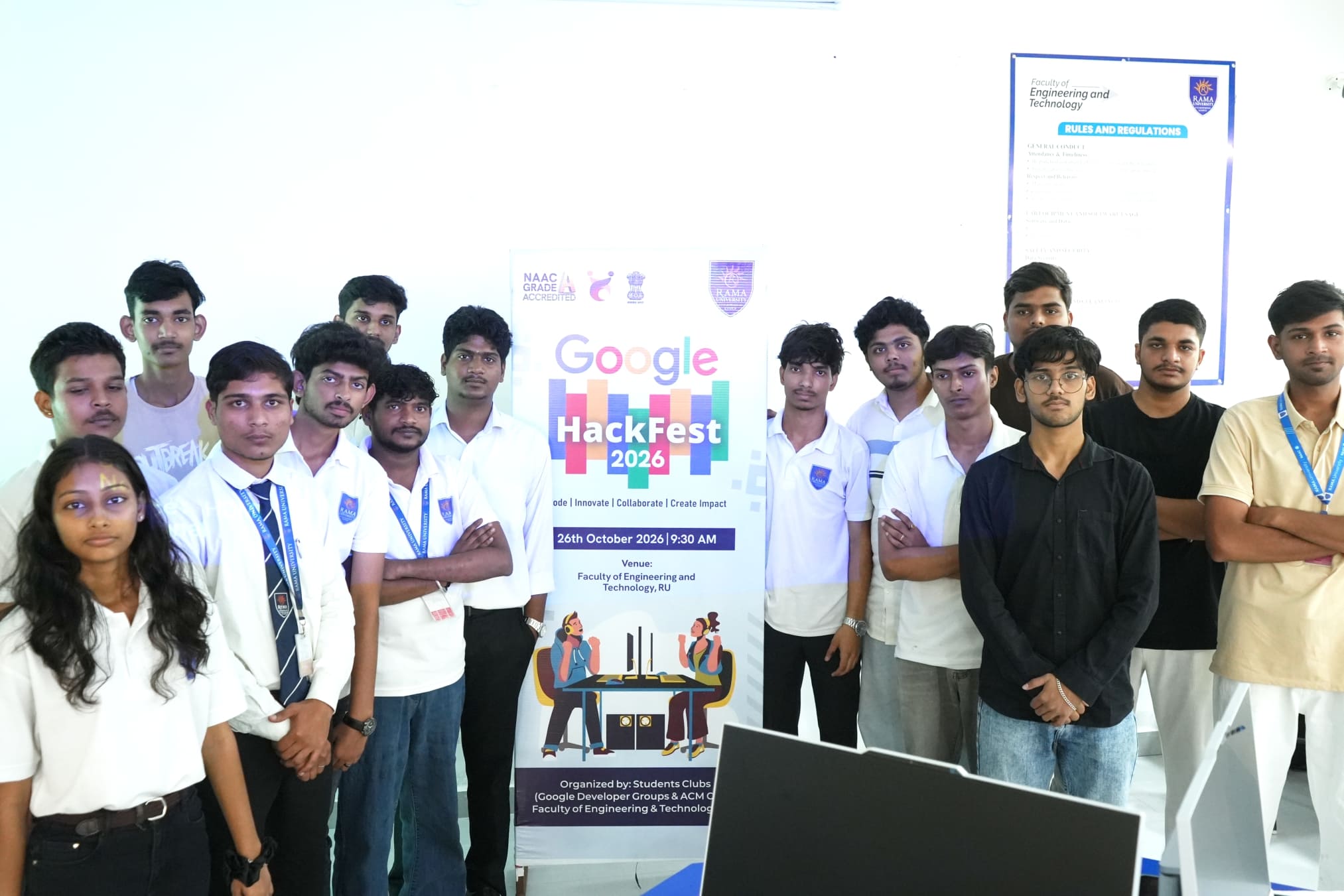
Google HackFest 2026
Code | Innovate | Collaborate | Create Impact
Date: 26 October 2026
Time: 9:30 AM onwards
Venue: Computer Lab 03026, Faculty of Engineering & Technology, Rama University
Organized by: Students Clubs (Google Developer Groups and ACM Club), Faculty of Engineering & Technology, Rama University
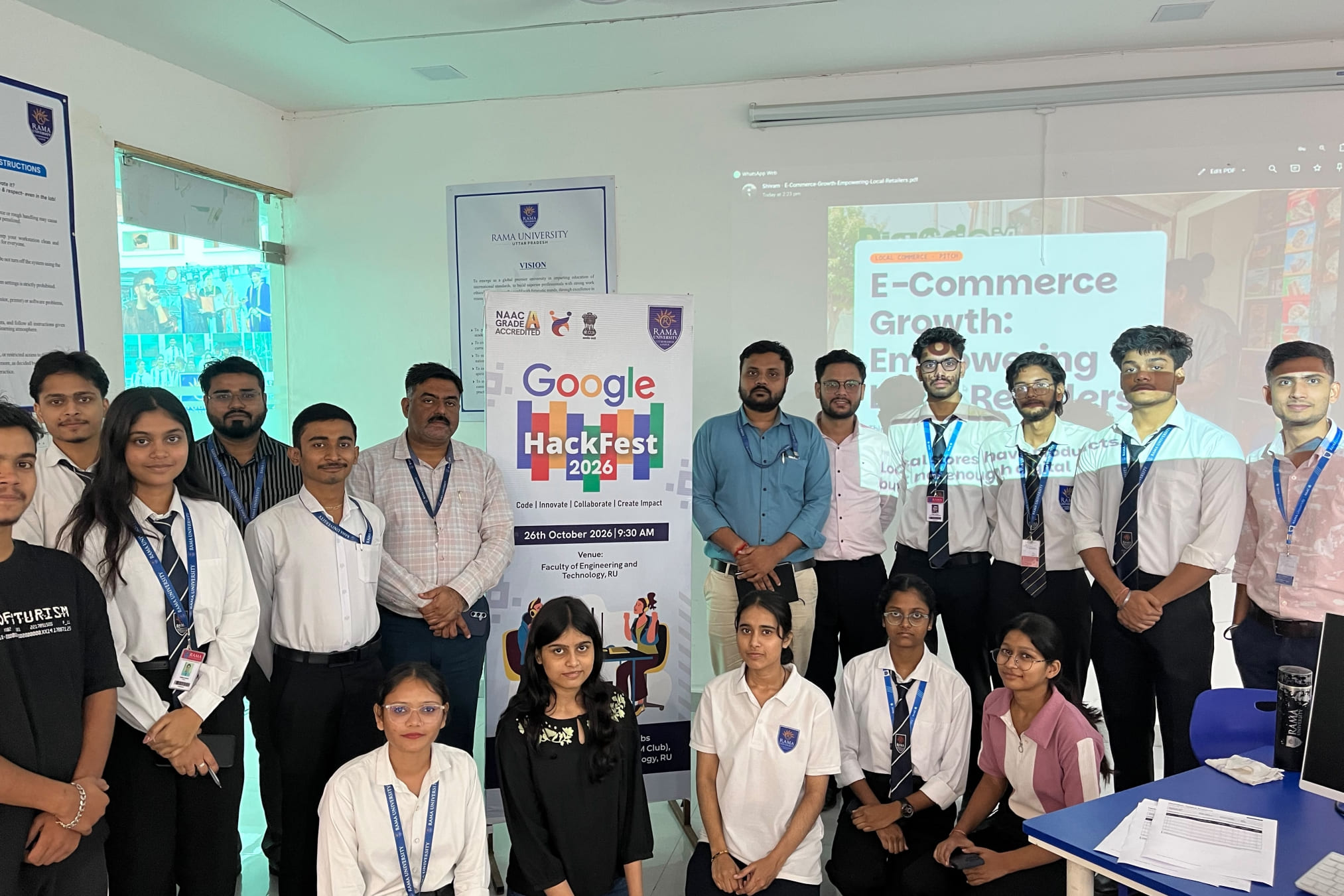
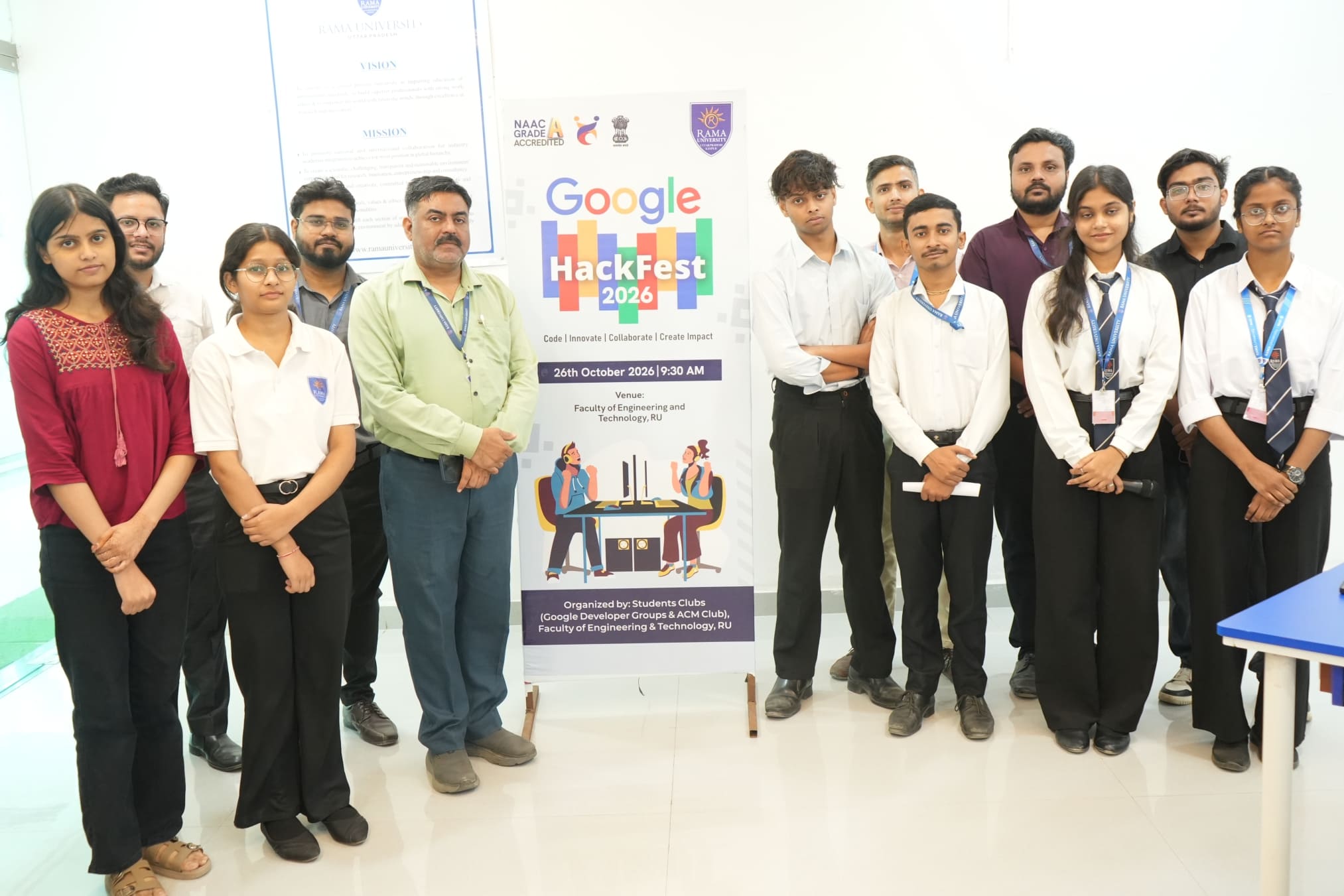
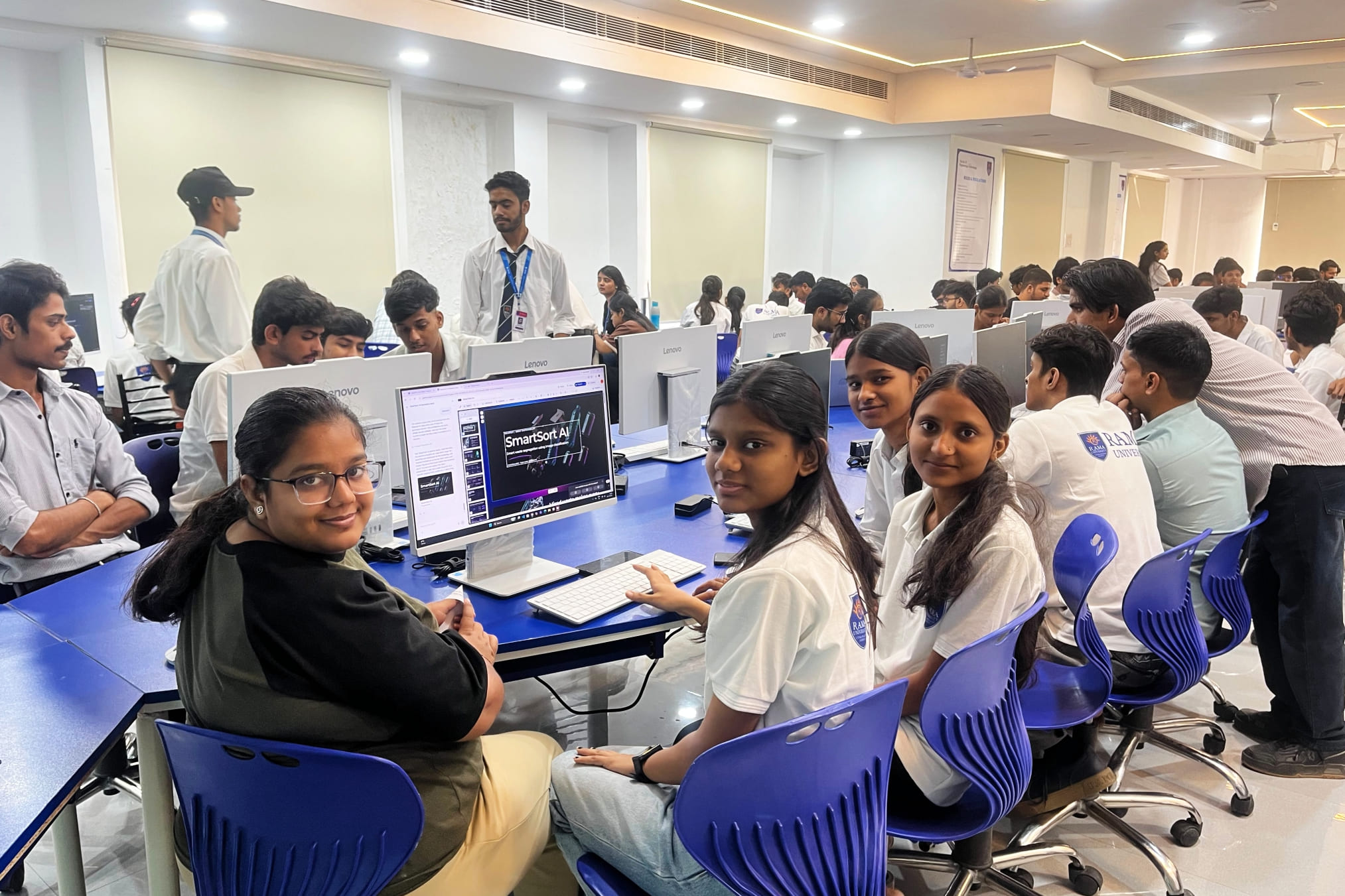
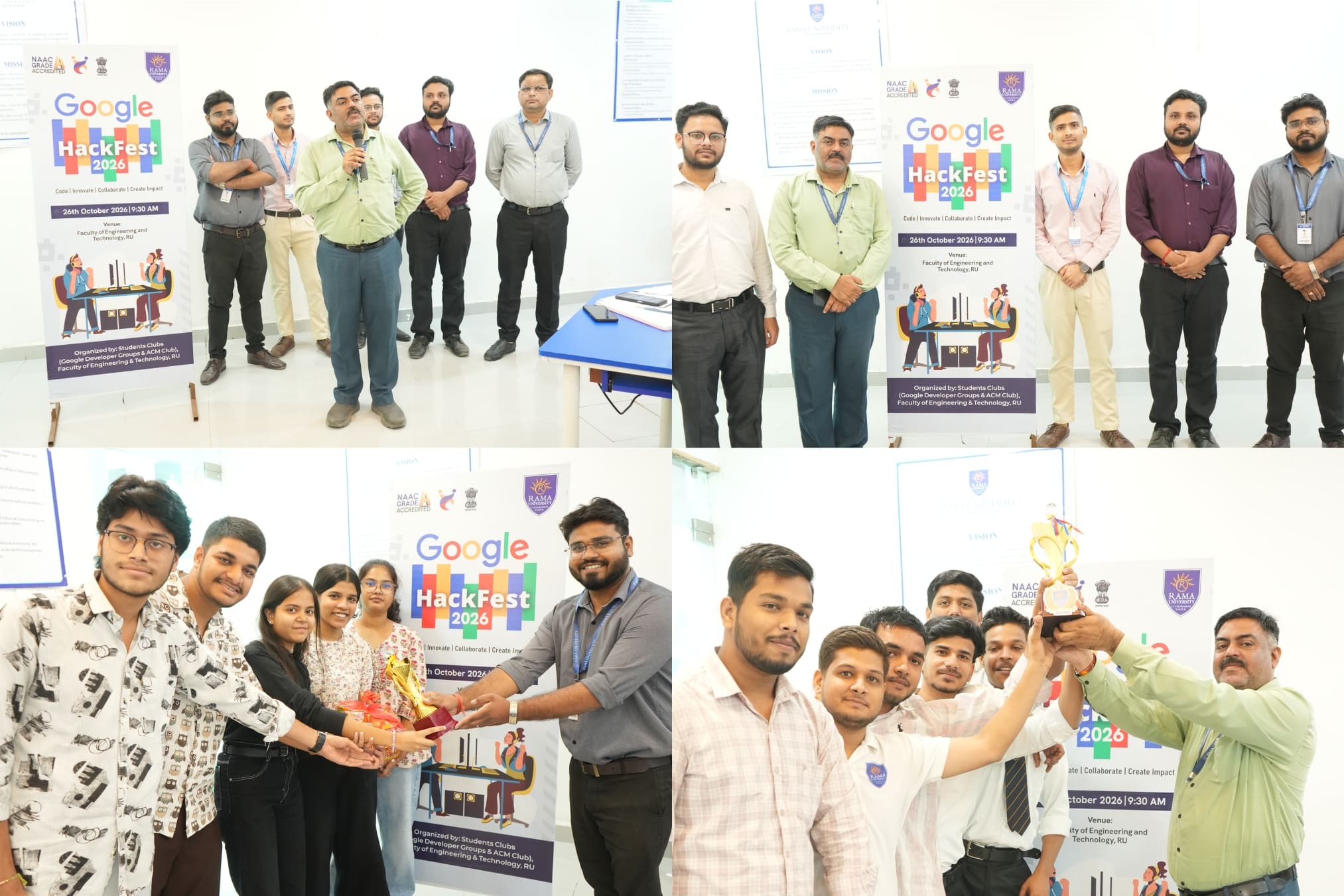
The Faculty of Engineering & Technology (FET), Rama University, achieved a remarkable milestone through the participation and outstanding performance of its students in Google HackFest 2026, organized on 26 October 2026. The event provided a platform for students to demonstrate their technical expertise, innovative thinking, collaborative skills, and ability to develop technology-driven solutions to real-world problems.
Organized by the Students Clubs, including Google Developer Groups and the ACM Club, the event was conducted under the theme “Code | Innovate | Collaborate | Create Impact.” It encouraged students to apply their programming knowledge, explore emerging technologies, and transform their ideas into practical applications.
The students demonstrated an impressive range of innovative solutions spanning artificial intelligence, bioinformatics, sustainable agriculture, business intelligence, local business discovery, and recruitment automation. Their achievements reflected the growing culture of innovation, entrepreneurship, and practical technology development at Rama University.
Objectives of the Event
The major objectives of Google HackFest 2026 were:
- To encourage students to develop innovative and technology-driven solutions to real-world challenges.
- To strengthen programming, analytical thinking, and software development skills.
- To promote the application of artificial intelligence and emerging technologies in diverse fields.
- To develop teamwork, collaboration, creativity, and effective presentation skills.
- To encourage students to explore entrepreneurship and transform innovative ideas into potential products and services.
- To provide practical exposure to problem identification, solution development, and technical pitching.
- To foster a competitive and innovation-oriented environment among students.
Highlights of Student Achievements
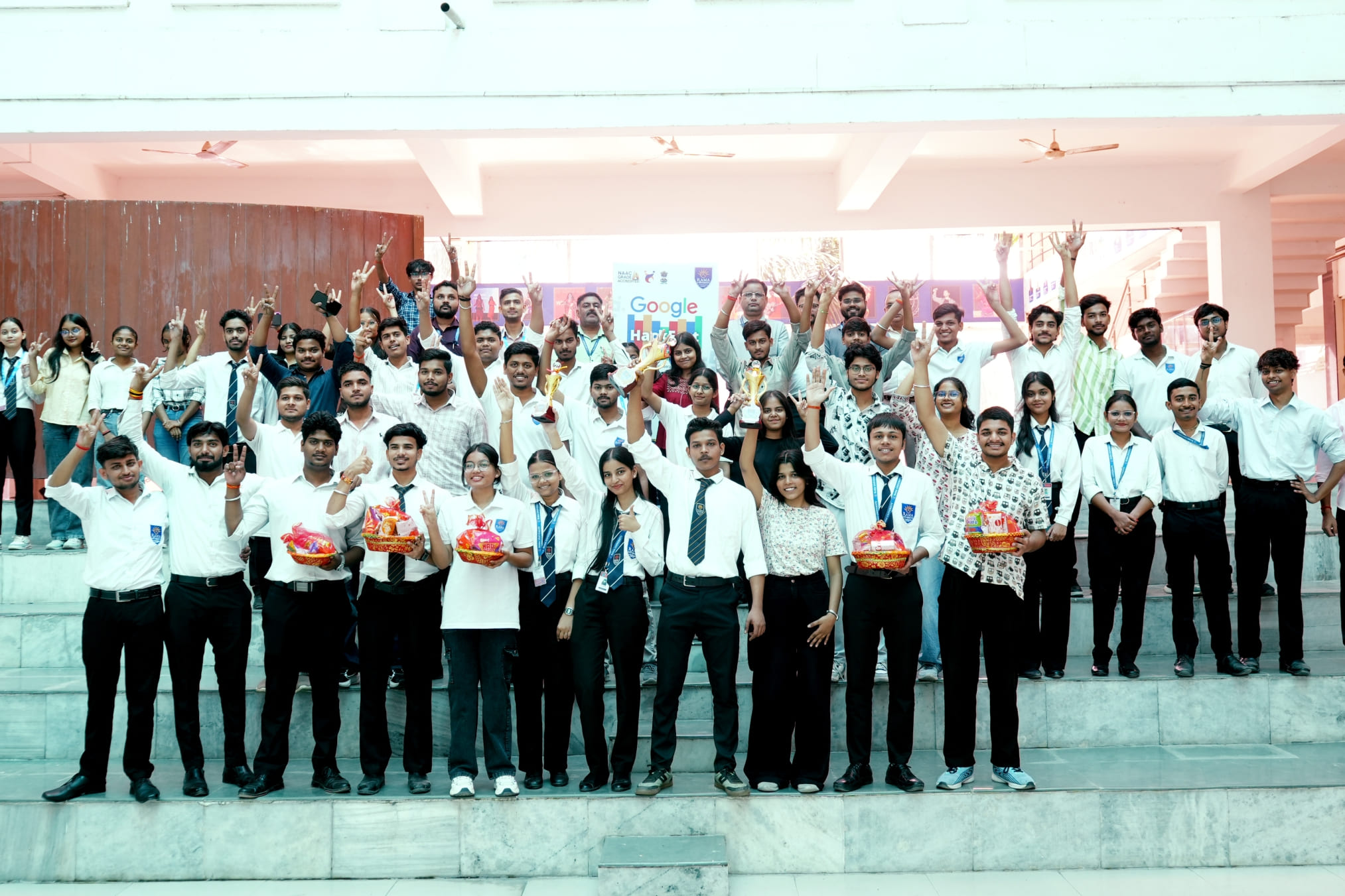
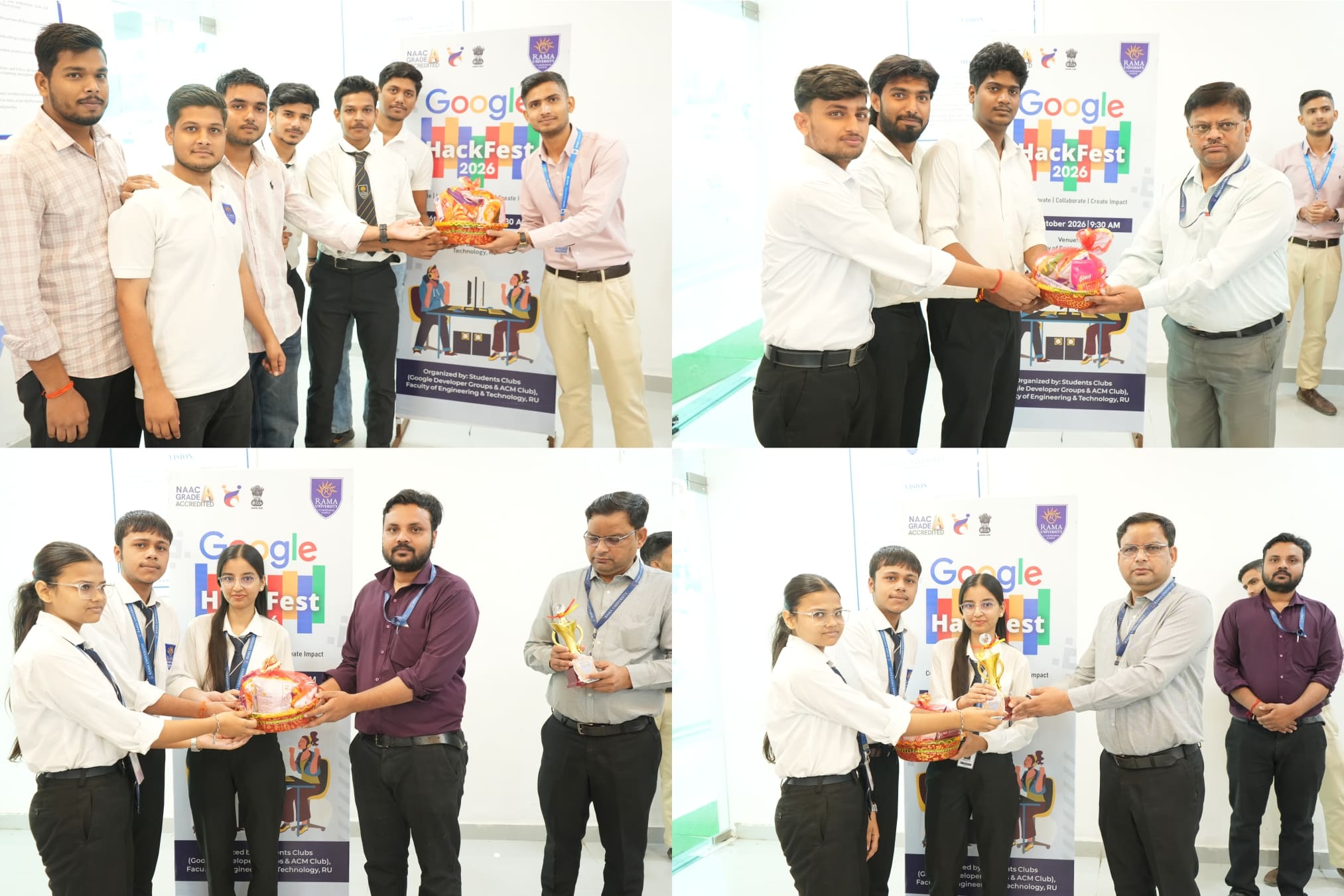
The students of the Faculty of Engineering & Technology demonstrated exceptional creativity and technical capability by securing the first five positions with projects addressing important challenges across different sectors.
The winning teams presented solutions that combined technology, practical problem-solving, and the potential for real-world application.
|
Position
|
Team Name
|
Project Title
|
Key Innovation
|
|
1st Rank
|
Green Glitch
|
AgriCycle – Turn Farm Waste into Wealth
|
An AI-powered agricultural residue management platform connecting farmers with buyers and promoting sustainable waste utilization.
|
|
2nd Rank
|
Viscous Anonymity
|
Genomic Analysis and Predictive Protein Structure Platform
|
An integrated bioinformatics application for DNA sequence comparison, mutation analysis, ORF detection, codon analysis, and predictive 3D protein structure modelling.
|
|
3rd Rank
|
Elite Hunters
|
Local Connect – Connecting Local Businesses with Customers
|
An AI-powered platform designed to simplify local business discovery and help small businesses improve their digital visibility.
|
|
4th Rank
|
Nanchacku Nodes
|
MarketLens AI – Understand Your Market. Find Your Opportunity.
|
An AI-powered market intelligence platform for competitor analysis, customer signal evaluation, opportunity discovery, and startup validation.
|
|
5th Rank
|
Binary Brains
|
Abhi X – AI-Powered Business Automation Platform
|
An integrated platform combining AI-based resume screening, B2B lead generation, and WhatsApp automation.
|
Overview of the Award-Winning Projects
First Rank: Team Green Glitch – AgriCycle
Team Green Glitch secured the first position with AgriCycle, an innovative platform addressing the critical issue of agricultural residue management. The solution aims to help farmers convert agricultural waste into valuable resources through AI-based recommendations, market connectivity, price and profit estimation, and information about government schemes and subsidies.
The project stood out for its emphasis on sustainable agriculture, environmental protection, and additional income opportunities for farmers. By connecting agricultural residue with potential commercial applications such as composting, mulching, and biofuel production, the team demonstrated how technology can contribute to rural entrepreneurship and a circular agricultural economy.
Second Rank: Team Viscous Anonymity – Genomic Analysis and Predictive Protein Structure Platform
Team Viscous Anonymity secured the second position by developing an end-to-end bioinformatics application designed to simplify the analysis of genomic data. The platform integrates DNA sequence comparison with reference sequences, mutation identification, open reading frame detection, codon usage analysis, and predictive three-dimensional protein structure modelling.
The project's key strength lies in connecting genomic variations with potential structural changes in proteins through a unified computational workflow. It demonstrated the potential of computational biology and bioinformatics tools to support researchers in genetic analysis and the investigation of genetic variants.
Third Rank: Team Elite Hunters – Local Connect
Team Elite Hunters secured the third position with Local Connect, an AI-powered platform designed to bridge the gap between local businesses and customers. The solution aims to help users discover relevant businesses based on location, services, and individual requirements while enabling small business owners to strengthen their online presence.
The project addressed an everyday challenge faced by consumers and small entrepreneurs. Its focus on intelligent search, location-based discovery, business profiles, and personalised recommendations highlighted the potential of AI in improving local commerce and supporting small-business growth.
Fourth Rank: Team Nanchacku Nodes – MarketLens AI
Team Nanchaku Nodes secured the fourth position with MarketLens AI, a market intelligence platform designed to support startups and businesses in making informed decisions.
The platform incorporates competitor analysis, customer feedback clustering, willingness-to-pay assessment, opportunity identification, and structured market validation workflows. A notable feature is its proposed four-tier evidence classification system, which distinguishes verified information from user signals, AI-generated inferences, and unverified findings.
The project demonstrated a strong understanding of the challenges faced by early-stage startups, particularly the need for reliable market information, affordable research, and evidence-based business planning.
Fifth Rank: Team Binary Brains – Abhi X
Team Binary Brains secured the fifth position with Abhi X, an AI-powered platform designed to combine three business functions: B2B lead generation, AI-based resume screening, and WhatsApp automation.
The resume screening module extracts relevant information from resumes, compares candidate profiles with job requirements, and presents matching skills, missing skills, and an interpretable match score. The proposed scoring model considers required skills, preferred skills, and relevant experience to assist recruiters in reviewing applications.
By integrating recruitment support, lead discovery, and communication automation, the team demonstrated an understanding of how AI can reduce repetitive tasks and improve business workflow efficiency. The project also highlighted the importance of keeping human recruiters involved in final hiring decisions.
Conclusion
Google HackFest 2026 was a significant achievement for the Faculty of Engineering & Technology, Rama University. The success of the student teams, particularly their securing of the first five positions, highlighted the institution's commitment to fostering technical excellence, innovation, collaboration, and entrepreneurial thinking.
The winning projects demonstrated that students can go beyond theoretical learning to develop technology-driven solutions for meaningful real-world challenges. From sustainable agricultural practices and genomic research to local business development, startup intelligence, and AI-powered automation, the projects showcased the breadth of innovation emerging among the students.
The achievement serves as a source of pride for the Faculty of Engineering & Technology and an encouragement for the wider student community to pursue creative ideas, develop practical solutions, and participate actively in future innovation initiatives.
Google HackFest 2026 stands as a proud accomplishment for the students of FET, Rama University, reinforcing the spirit of innovation and the vision of transforming ideas into impactful solutions.